
 Introduction
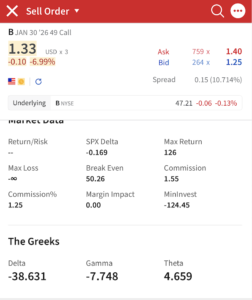
Selling a covered call on Barrick Mining marked the first execution of the strategy after completing the 100-share position. The option sold was the January 30, 2026 $49 call, generating a premium of $1.33 per share, or $133 in total income for one contract. This trade established a strike price above the average purchase cost while allowing some potential upside if the stock continued to rise.
Covered calls are commonly used by investors who already own shares and want to generate additional income from their holdings. By selling the option contract, the seller receives a premium upfront while agreeing to sell the shares at the strike price if the option is exercised before expiration.
Covered Call Trade Summary
Underlying: Barrick Mining Corporation (B)
Position Size: 100 Shares
Option: Sold
Expiration: January 30, 2026
Strike Price: $49 Call
Premium Received: $1.33 per share
Total Premium Collected: $133
Contract Size: 1 option contract (100 shares)
Option Metrics at Entry: Delta: -0.38 (approximately 62% probability of expiring worthless), Theta: 4.6 (about $4 of time decay per day benefiting the seller)
These option characteristics reflect a moderate probability that the contract will expire without assignment while allowing time decay to gradually reduce the option’s value as expiration approaches.
Understanding the Covered Call Strategy
A covered call begins by placing a “sell to open” order on a call option while already owning the underlying shares. Because the shares are held in advance, the obligation created by the option contract is fully covered.
If the option is exercised, the shares are sold at the strike price. If the option expires worthless, the premium is kept and the shares remain in the account.
This structure allows traders to generate additional income while holding stocks they are comfortable owning over time.
Option Greeks and Trade Behavior
Several option metrics help explain how the position behaves.
Delta estimates how much the option price may change when the underlying stock moves. A delta of -0.38 suggests a moderate probability that the option will expire worthless.
Theta measures time decay. Since option value decreases as expiration approaches, theta works in favor of the option seller by gradually reducing the value of the contract each day.
Gamma measures how quickly delta can change when the stock price moves. Higher gamma typically appears closer to expiration.
These metrics help traders understand the probability and behavior of the position rather than relying solely on price predictions.
Possible Covered Call Outcomes
There are several potential outcomes when selling a covered call.
📈 Stock rises but remains below the strike price The option expires worthless:
The premium is kept as income and the shares remain owned. (Excellent).
📈 Stock rises above the strike price:
The option may be assigned and the shares are sold at the strike price. The premium is still kept, resulting in a capped but defined profit with an “opportunity lost”. (Good).
➡️ Stock moves sideways:
The option can expire worthless while the premium becomes income and the shares remain in the portfolio. (Good).
📉 Stock declines significantly:
The premium provides limited protection against downside movement. Losses may occur if the stock price falls substantially, highlighting the importance of selecting stocks that are acceptable to hold long-term. (Not Ideal).
Covered Call Trade Summary
Underlying Stock: Barrick Mining Corporation (Ticker: B)
Total Position Size: 100 Shares
Average Share Price: $42.74
Total Capital Invested: $4,274
Option Contract Sold
Strategy: Covered Call
Expiration Date: January 30, 2026
Strike Price: $49 Call
Contracts Sold: 1 Contract (100 Shares)
Premium Collected
Option Premium: $1.33 per share
Total Premium Received: $133
This premium is credited to the account immediately after the order is filled.
Combined Position Overview
The covered call combines the stock position and the short call option, creating a structured trade with defined outcomes.
-
Shares owned: 100 Barrick Mining shares
-
Average share price: $42.74
-
Call option sold: $49 strike
-
Premium collected: $133
If the option expires worthless, the premium becomes income while the shares remain owned. If the option is exercised, the shares are sold at $49 per share, locking in both the capital gain and the option premium.
Outcome of the First Covered Call
As expiration approaches, the final outcome of the position depends on where Barrick’s stock price closes relative to the $49 strike price.
If the stock remains below the strike price, the option expires worthless and the premium becomes realized income while the shares remain owned. If the stock finishes above the strike price, the shares may be assigned and sold at the strike price, completing the covered call cycle.
Covered Call Trade Series
Part 1 – Barrick 50 Shares
Part 2 – Barrick 75 Shares
Part 3 – Barrick 100 Shares
Part 4 – First Covered Call on Barrick
Part 5 – Covered Call Outcome