
A Real Gamble Call Trade
This post documents another real options trade within the ongoing “Gamble Call” series, where short-dated call options are purchased and tracked to evaluate how often these speculative trades succeed or fail.
On February 27, 2026, a short-dated call option was initiated on Hecla Mining Company with an expiration of March 6, 2026.
The position was opened using:
-
Strike price: $24.50
-
Premium paid: $1.26
This created a break-even level of $25.76.
At entry, the option carried a delta of approximately 0.52, indicating moderate sensitivity to upward price movement. Theta was −13.2, reflecting rapid time decay due to the short time remaining before expiration. Despite expectations for near-term momentum, the underlying stock failed to rise toward the break-even threshold.
Unexpected Downward Move
A few days after the position was opened, Hecla Mining shares experienced a sharp and unexpected decline.
The stock price fell to approximately $21, placing the underlying well below the $24.50 strike price and significantly beneath the $25.76 break-even level required for profitability.
With expiration approaching on March 6, 2026, the probability of a meaningful recovery within such a short time frame became extremely low. Short-dated options require not only the correct direction but also a large enough move within a limited period of time.
Option Nearly Worthless
HL Option Chain 20260305
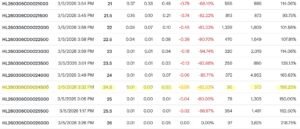
With only one day remaining before expiration, the option lost nearly all of its remaining value and was trading for approximately $0.01.
At this stage, the option is effectively worthless from a practical trading perspective. Even if the contract technically still exists, the premium remaining is so small that it provides little opportunity to recover meaningful value.
Why Rolling the Position Would Not Help
With the option trading for only a penny, rolling the position would provide very little practical benefit.
Rolling typically involves closing the current position and opening a new one with a later expiration. However, when the remaining premium is negligible, there is almost nothing left to apply toward the cost of a new trade.
In situations like this, allowing the contract to expire worthless is often the simplest and most reasonable course of action.
Once time decay accelerates during the final days before expiration, recovery becomes extremely difficult unless the underlying stock makes a rapid and substantial move.
A Pattern in Gamble Calls
This outcome reinforces a pattern that has become increasingly clear while tracking these trades.
So far, more than 80% of my Gamble Call purchases have failed to produce a profit.
Short-term directional option trades require being correct about:
-
direction
-
magnitude of the move
-
timing before expiration
If any one of these variables fails to align, the option quickly loses value.
Why Many Traders Prefer Selling Options
This experience highlights why many traders prefer strategies that sell options rather than buy them.
Strategies such as:
benefit directly from time decay.
Instead of working against theta, option sellers allow time decay to gradually reduce the value of the contract. In those cases, options expiring worthless is actually the desired outcome, because the seller keeps the entire premium.
This trade continues the experiment documented in the previous Gamble Call: February 27, 2026 post.