
What Is IBKR ForecastTrader?
The official platform, IBKR ForecastTrader, is a specialized interface developed by Interactive Brokers and powered by ForecastEx LLC. It allows traders to participate in event-driven markets by trading “Forecast Contracts” or “Event Contracts.”
Instead of trading stocks or traditional options, this platform focuses on real-world outcomes such as economic data releases, climate events, or price thresholds in financial markets. Each contract represents a simple question with a binary outcome, something either happens, or it does not.
This transforms trading into a structured form of probability-based decision-making, where the goal is not to predict magnitude, but simply whether an event will occur.
How It Works
Forecast contracts operate on a binary pricing system:
-
Contracts trade between $0.02 and $0.99
-
Each contract settles at $1.00 if correct
-
If incorrect, the contract settles at $0.00
Traders choose between:
-
“Yes” contracts → Betting the event will happen
-
“No” contracts → Betting the event will not happen
Example Structure:
-
Buy at $0.40
-
If correct → Receive $1.00
-
Profit → $0.60
-
If wrong → Lose $0.40
This creates a fixed risk / fixed reward structure, similar to options; but simplified.
Key Features of IBKR ForecastTrader
1. Defined Risk and Reward
Every trade has a clearly defined maximum gain and loss from the start. There are no complex payoff curves or changing Greeks.
2. Event-Driven Focus
Contracts are based on:
-
Economic indicators
-
Commodity price levels
-
Weather or climate outcomes
-
Public policy events
This makes it different from traditional trading, where price movement alone drives outcomes.
3. Simple Pricing Model
Unlike options, there is:
-
No implied volatility modeling
-
No time decay (theta) in the traditional sense
-
No multi-variable pricing
The price directly reflects market probability.
4. Accessibility
The platform is available through web and mobile, making it easy to monitor and trade events in real time.
**Unlike options, these contracts offer little flexibility once entered. If the outcome begins to move against the position, there is often limited or no practical ability to exit at a favorable price, especially as the event approaches. In most cases, the trader is forced to hold the contract until settlement, making the outcome truly all-or-nothing.
My First Trade (Gold Market)
The first position placed on this platform was:
-
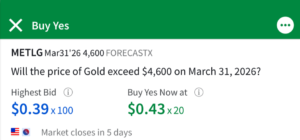
Contract: METLG; Mar31’26 4,600
-
Question: Will gold exceed $4,600 by March 31, 2026?
-
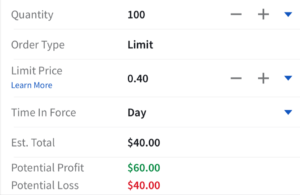
Quantity: 100 contracts
-
Entry Price: $0.40
-
Total Cost: $40
Risk and Reward:
-
Maximum Profit: $60 (if correct)
-
Maximum Loss: $40 (if incorrect)
This trade represents a clear probability bet. At $0.40, the market is implying roughly a 40% chance that gold will exceed $4,600 by the specified date.
How These Contracts Are Similar to Options (But Simpler)
Forecast contracts share similarities with options:
-
Both involve probability-based pricing
-
Both allow leveraged exposure with limited capital
-
Both can produce large percentage returns
However, the key difference is simplicity
|
Feature |
Options |
Forecast Contracts |
|---|---|---|
|
Outcome |
Variable payoff |
Binary (Yes/No) |
|
Pricing |
Complex (Greeks, IV) |
Direct probability |
|
Risk |
Defined but dynamic |
Fully fixed |
|
Strategy |
Multi-leg possible |
Single decision |
In essence, forecast contracts remove complexity and focus entirely on being right or wrong.
Pros and Cons
Pros:
-
Simple and intuitive structure
-
Defined risk and reward
-
No complex calculations
-
Clear probability-based decisions
-
Lower capital requirement
Cons:
-
Binary outcome (no partial wins)
-
Limited contract selection (currently)
-
No ability to adjust or hedge like options
-
Requires precise timing of events
-
Can encourage overtrading
Understanding Probabilities and Risk–Reward
A critical element of trading forecast contracts is understanding how price translates into both implied probability and reward-to-risk. Purchasing a contract at $0.40 implies approximately a 40% probability of success, while risking $0.40 to earn $0.60 results in a reward-to-risk ratio of 1.5:1, not the 2:1 ratio many traders typically seek.
In contrast, buying the same contract at $0.30 implies a 30% probability of success but offers a significantly more favorable reward-to-risk profile of approximately 2.33:1 (risk $0.30 to make $0.70).
Professional traders often prioritize asymmetric setups,commonly targeting at least 2:1 reward-to-risk, because profitability over time depends not only on win rate but on how much is gained relative to what is lost.
For example:
Over five trades at $0.30, winning just two and losing three would result in a net profit: gains of $1.40 (2 × $0.70) versus losses of $0.90 (3 × $0.30).
By comparison, at $0.40, the same 2 wins and 3 losses would produce a net loss: gains of $1.20 (2 × $0.60) versus losses of $1.20 (3 × $0.40), effectively breaking even before costs.
This demonstrates a key principle: lower-probability trades with stronger payoff asymmetry can outperform higher-probability trades with weaker reward structures over a series of outcome.
Why It Feels Like Gambling (Similar to Buying Options)
These contracts closely resemble the psychology of gambling.
Like short-dated options:
-
A small amount of capital can produce large returns
-
Outcomes are often all-or-nothing
-
Timing plays a critical role
-
Probability is often misunderstood
At $0.40, the trade may feel cheap, but the reality is: There is still a 60% chance of losing everything.
This mirrors the behavior seen in “gamble calls,” where traders are attracted to low-cost, high-reward setups without fully accounting for probability.
The structure is clean, but the psychological risk remains the same.
Conclusion
IBKR ForecastTrader introduces a new way to interact with markets by focusing on outcomes rather than price movement. It simplifies trading into a binary decision: will an event happen or not? While this removes much of the complexity found in options trading, it does not remove risk. In fact, the simplicity can make the risk easier to underestimate.
Used correctly, these contracts can serve as a tool for expressing macro views or testing probability-based thinking. Used incorrectly, they can quickly resemble speculative gambling.
{March 31, 2026}
This section will document the final outcome of the trade:
-
Did gold exceed $4,600? YES ($4,721)
-
Did the contract settle at $100 or $0.00? 100
-
Final profit or loss: $60 profit!!


This update completes the trade and provide a full evaluation of how event-driven contracts behave in real market conditions.
Gambling the Market:
This was helpful, but the odds don’t seem like you will get enough pay for the “trouble.”